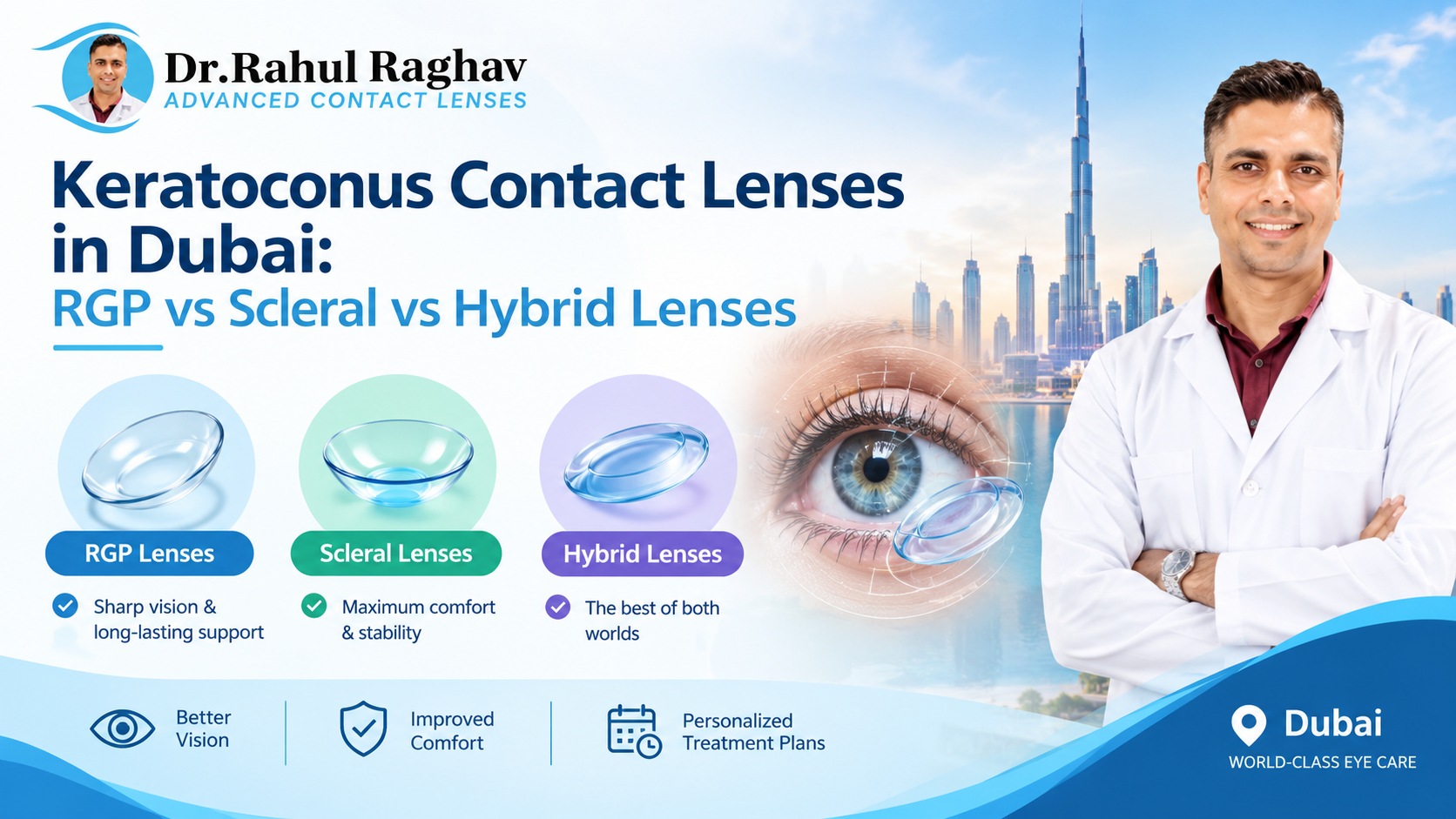

Choosing the right doctor for keratoconus is important. Keratoconus changes the shape of the clear front part of the eye, called the cornea, cornea to thin and bulge, changing its shape. As a result, a person may have blurred and distorted vision with glare and light sensitivity.
Changes in glasses prescription may not be corrected with stronger prescription lenses. Dr. Rahul Raghav has 16 years of experience in dealing with eye conditions like keratoconus.
In the United Arab Emirates, particularly Dubai, there are many eye care professionals who offer treatments for keratoconus. The level of advancement of the condition will determine the type of treatment and how frequently the doctor will need to examine the cornea.
Mild to moderate cases of keratoconus can be treated with corneal cross-linking, the use of special contact lenses, and/or eyeglasses. Surgery may be recommended for severe cases of the condition.
The purpose of this article is to provide prospective patients with information regarding keratoconus treatment in Dubai and the eye care professionals in Dubai who manage the condition.
What Is Keratoconus?
Keratoconus is a progressive condition in which the cornea becomes thinner and gradually develops an irregular, cone-like shape. Because the cornea is responsible for focusing light into the eye, changes in its shape can lead to irregular astigmatism and distorted vision.
Common symptoms can include:
- Blurred or distorted vision
- Frequent changes in glasses prescription
- Increased sensitivity to light and glare
- Difficulty seeing clearly at night
- Ghost images or double vision in one eye
- Increasing difficulty with conventional contact lenses
Early diagnosis and regular monitoring are important because treatment depends on whether the condition is stable or progressing.
How Is Keratoconus Diagnosed?
Doctors use different eye tests to check for keratoconus. These tests help them see the shape, thickness, and health of the cornea.
They may use:
- Corneal topography: Makes a map of the cornea.
- Corneal tomography: Checks the front and back of the cornea.
- Pachymetry: Measures how thick the cornea is.
- Slit-lamp exam: Helps the doctor look closely at the eye.
- Vision test: Check how clearly you can see.
- Refraction test: Check your glasses prescription.
- Contact-lens check: Helps find the right special lenses if needed.
Top 5 Doctors for Keratoconus Treatment in Dubai
1. Dr. Rahul Raghav – Keratoconus & Specialty Contact Lens Specialist
Experience: More than 16 years
Specialty: Keratoconus, scleral lenses and specialty contact lenses
Location: Quirónsalud Specialty Hospital, Umm Al Sheif, Dubai
Dr. Rahul Raghav is an optometrist who focuses on specialty contact lenses and keratoconus care. He has experience with scleral, hybrid and RGP lenses.
He has experience with keratoconus treatment, including corneal cross-linking and intracorneal ring segment (Intacs) procedures.
His professional website says he has received training in specialty contact lenses and orthokeratology in the USA and Spain. He also works with corneal surgeons when patients need surgical treatment.
Specialty lenses can help people with keratoconus see more clearly when normal glasses or regular contact lenses do not work well.
Why patients may consider Dr. Rahul Raghav:
- Experience with keratoconus
- Scleral lens fitting
- Hybrid and RGP lenses
- Postgraduate training in optometry
- Training in specialty contact lenses
- Experience with irregular corneas
The 16-year experience figure is provided for this article brief. His website currently shows different experience figures on different pages, so patients should confirm his current experience with the clinic.
Dr. Rahul Raghav – Official Website
Dr. Rahul Raghav – Qurionsalud Hospital
2. Dr. Pramod Warhekar – Keratoconus & Corneal Cross-Linking
Experience: More than 25 years
Specialty: Ophthalmology, keratoconus, corneal cross-linking and Intacs
Hospital: Mediclinic City Hospital, Dubai
Dr. Pramod Warhekar is an ophthalmologist with more than 25 years of experience.
He has experience with keratoconus treatment, corneal cross-linking and intracorneal ring segments (Intacs).
Corneal cross-linking may help strengthen the cornea and slow down keratoconus progression. A doctor needs to check the patient’s eyes first to see if this treatment is suitable.
Dr. Pramod Warhekar – Mediclinic Middle East
3. Dr. M. Nour Haydari – Cornea & Keratoconus Specialist
Specialty: Cornea, anterior-segment surgery and keratoconus
Hospital: Mediclinic Dubai Mall / Mediclinic Parkview Hospital
Dr. M. Nour Haydari is an eye doctor who specializes in cornea and eye surgery.
His professional profile lists keratoconus treatment, corneal cross-linking and corneal transplantation among his areas of expertise.
He also completed a Corneal Surgery Fellowship at the University of Montreal in Canada.
He may be relevant for patients who need more than contact lenses, especially when keratoconus is progressing or the cornea has significant changes.
Dr. M. Nour Haydari – Mediclinic Middle East
4. Dr. Osama Giledi – Cornea & Refractive Surgery Specialist
Specialty: Cornea, anterior segment and refractive surgery
Hospital: Moorfields Eye Hospital Dubai
Dr. Osama Giledi is an eye surgeon who specializes in cornea and refractive surgery.
Moorfields Eye Hospital says he provides keratoconus treatments such as corneal cross-linking, intracorneal ring segments and complex laser treatment.
He also has advanced training in corneal surgery from the UK.
Dr. Osama Giledi – Moorfields Eye Hospital UAE
5. Dr. Qasiem Nasser – Cornea & Anterior Segment Specialist
Specialty: Cornea, cataract, anterior-segment surgery and keratoconus
Hospital: Moorfields Eye Hospital Dubai
Dr. Qasiem Nasser is an eye doctor with special training in cornea and anterior-segment surgery.
His Moorfields profile lists corneal cross-linking for keratoconus as one of his areas of expertise.
He also treats other corneal and eye conditions, including cataracts and refractive problems.
Dr. Qasiem Nasser – Moorfields Eye Hospital UAE
Keratoconus Treatment Options in Dubai
There is no single treatment that is considered suitable for every keratoconus patient. Treatment depends on factors such as age, corneal thickness, severity, visual needs and whether the condition is progressing.
Glasses
In early or mild cases, glasses may provide useful vision correction, particularly when the irregularity of the cornea is limited.
Specialty Contact Lenses
As keratoconus progresses, irregular astigmatism can make glasses less effective. Specialty contact lenses, including RGP, hybrid and scleral lenses, may help provide clearer vision by creating a more regular optical surface.
Corneal Cross-Linking
Corneal cross-linking (commonly referred to as CXL) is a surgical technique designed to help reinforce the cornea’s structural integrity. Typically, corneal cross-linking is recommended when an individual has developed signs of progressive keratoconus and meets all of the necessary criteria for undergoing this type of surgery.
Intracorneal Ring Segments
Intracorneal ring segments can be used in some patients. These rings are put inside the patient’s cornea to change the way the cornea looks; they can also make the surface of the cornea smoother than before.
Corneal Transplantation
In advanced keratoconus, particularly when there is significant corneal scarring or severe visual impairment that cannot be adequately managed with other approaches, a corneal transplant may be considered.
The appropriate treatment should always be determined following a detailed examination by a qualified eye-care professional.
Why Is Early Keratoconus Assessment Important?
Keratoconus is different for every person. For some people, it may stay the same and can be managed with regular eye check-ups and glasses.
For others, it may get worse over time. These people may need more frequent eye tests and different treatments.
An early eye check-up helps the doctor understand the starting condition of the cornea. This gives the doctor something to compare with future eye scans.
Early and regular check-ups are especially important for young people and people who notice:
- Blurry vision
- Frequent changes in glasses
- Difficulty wearing contact lenses
- Vision getting worse quickly
Doctors can use corneal scans, vision tests, and prescription checks to see if the keratoconus is changing. People whose condition is progressing quickly may need check-ups more often.
Why Dr. Rahul Raghav Is an Option for Keratoconus Contact Lens Care
Keratoconus management can involve more than simply prescribing stronger glasses. When the cornea becomes irregular, finding a suitable contact-lens design can require detailed measurements, trial fitting and follow-up.
Dr. Rahul Raghav’s practice focuses particularly on specialty contact lenses and keratoconus-related lens fitting. His website identifies experience with scleral, hybrid and RGP lenses and treatment planning for patients with irregular corneas.
For patients who have difficulty achieving clear vision with conventional lenses, a specialty contact-lens assessment can help determine whether a different lens design may be appropriate.
Questions to Ask a Keratoconus Specialist
Before starting treatment, consider asking:
- Is my keratoconus stable or progressing?
- What do my corneal topography or tomography results show?
- How thick is my cornea?
- Do I need corneal cross-linking?
- Would scleral, RGP or hybrid contact lenses be suitable for me?
- How often should my cornea be monitored?
- Are there signs of corneal scarring?
- What should I do if my vision changes suddenly?
- Do I need to see a corneal surgeon?
- What are the expected benefits and limitations of the recommended treatment?
Final Thoughts
Choosing a keratoconus specialist in Dubai should be based on your individual diagnosis and the type of care you need. Some patients primarily need monitoring and specialty contact lenses, while others may require corneal cross-linking or surgical evaluation.
The five doctors covered in this guide have publicly documented experience relevant to keratoconus, including specialty contact-lens care, corneal cross-linking, intracorneal ring segments, and corneal surgery.
For patients specifically looking for keratoconus and specialty contact-lens management in Dubai, Dr. Rahul Raghav is an option to consider. His practice focuses on scleral, hybrid, and RGP contact lenses and keratoconus-related vision correction.
Important: This article is for general educational purposes and should not replace an examination or diagnosis from a qualified eye-care professional. Treatment suitability varies between patients. Always discuss your corneal scans, progression status, and treatment options with your eye-care specialist.