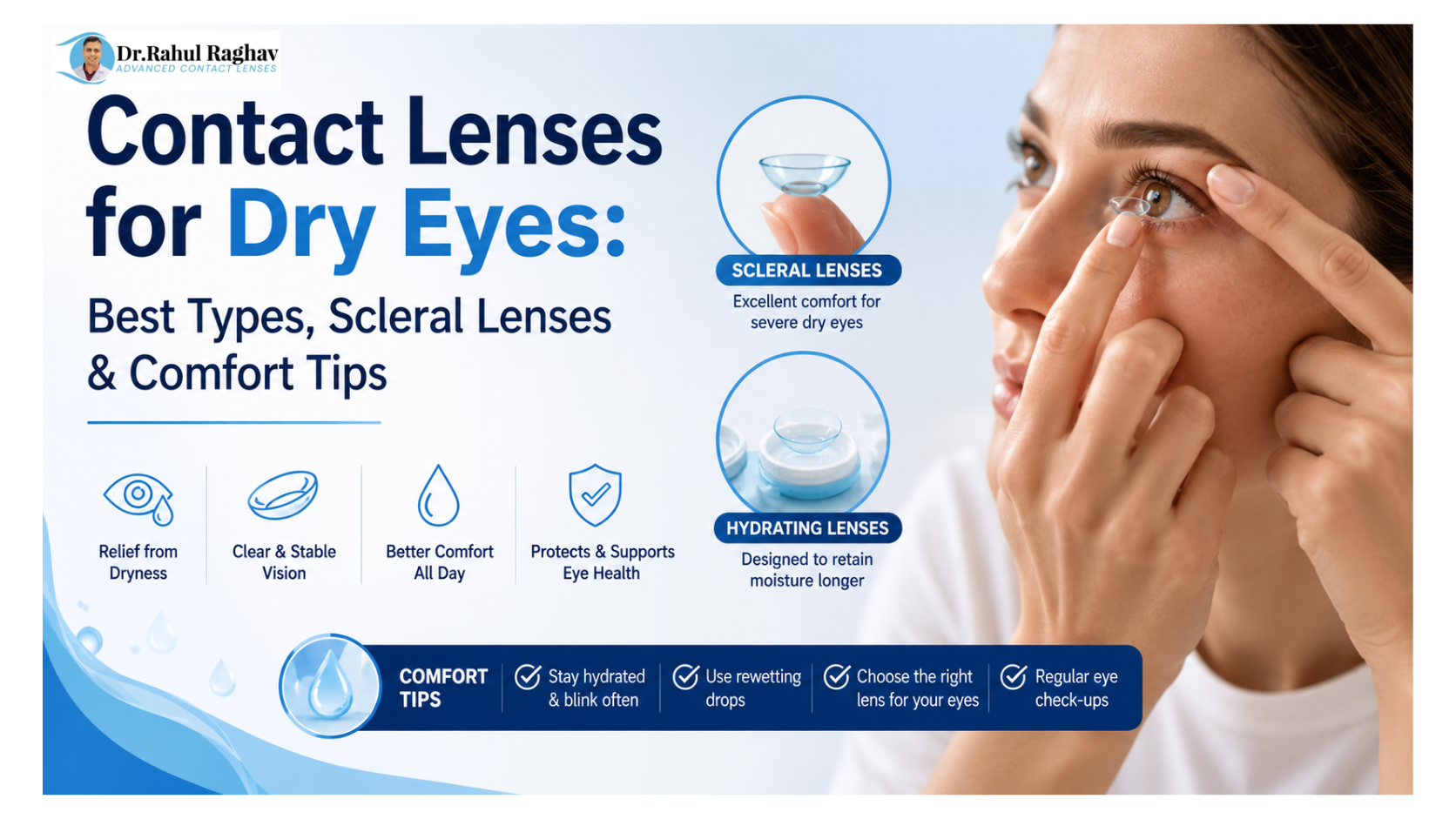
Finding comfortable contact lenses for dry eyes could be difficult. Burning, irritation, fluctuating vision, redness, or the sensation that something is stuck in the eye could make contact-lens wear uncomfortable.
The good news is that dry eyes do not automatically mean you have to stop wearing contact lenses. Depending on the cause and severity of your symptoms, an eye-care professional may need to change the lens material, replacement schedule, lens design, wearing time, or treatment for the underlying dry-eye condition.
For some people, daily disposable lenses may be appropriate. Others may benefit from a different soft-lens material, toric lenses for astigmatism, or specialty lenses such as scleral lenses.
There is no single “best” contact lens for everyone with dry eyes. The right choice depends on your eye health, prescription, tear film, corneal shape, lifestyle, and how your eyes respond to a particular lens.
What Are the Best Contact Lenses for Dry Eyes?
For some people with dry-eye symptoms, options that may be considered include:
- Daily disposable lenses: a fresh lens is used each day, which may reduce the accumulation of deposits connected with reusable lenses.
- Silicone hydrogel lenses: These materials generally help with substantial oxygen transmission, although oxygen transmission alone does not determine comfort.
- Toric lenses: Designed to correct astigmatism and available in several replacement schedules and materials.
- Scleral lenses: larger rigid gas-permeable lenses that vault over the cornea and maintain a fluid reservoir; they may be considered for severe dry eye or irregular corneas.
The best option should be determined after an eye examination and contact-lens fitting rather than by lens material alone.
What Causes Dry Eyes When Wearing Contact Lenses?
A contact lens interacts with the tear film covering the front of the eye. Changes to tear film stability, evaporation, blinking, lens movement, or the ocular surface could contribute to discomfort.
Common factors include:
Reduced blinking
People generally blink less frequently or incompletely during prolonged computer, phone, or other screen use. Reduced blinking could cause the tear film to break up more quickly and may worsen symptoms.
Lens material and surface properties
Different contact lenses have different materials, water content, surface characteristics, oxygen transmissibility, and designs. A lens that works comfortably for one person may feel dry or irritating to another.
Lens fit
A lens that moves so much, fits too tightly, or otherwise does not interact appropriately with the eye could contribute to discomfort or unstable vision.
Long wearing times
Even a well-fitted lens may become less comfortable when worn for longer than recommended. Your eye-care professional could advise you about an appropriate wearing schedule.
Environmental conditions
Air conditioning, fans, wind, dust, low humidity, and prolonged screen use could increase ocular surface discomfort.
Underlying eye conditions
Dry-eye symptoms could occur alongside conditions such as meibomian gland dysfunction, blepharitis, allergies, or other ocular-surface disorders. Treating the underlying condition may be just as important as changing the contact lens
Best Types of Contact Lenses for Dry Eyes
There is no universally best lens for dry eye. The goal is to find a lens that gives adequate vision while maintaining acceptable comfort and protecting ocular health.
1. Daily Disposable Contact Lenses
Daily disposable lenses are created to be worn for one day and then discarded.
For some contact-lens wearers with dryness or sensitivity, daily disposables may be worth discussing with an eye-care professional because a fresh lens is used each day and there is less opportunity for deposits to accumulate over repeated use.
Potential advantages include:
- A fresh lens every day
- No overnight storage of the lens
- No repeated cleaning of the lens itself
- Less opportunity for deposits to build up through repeated wear
- Convenience for occasional or frequent wearers
However, daily disposable does not automatically mean better comfort. The lens still needs to fit correctly, and your dry-eye condition may need treatment.
Never reuse a lens labeled for daily disposable use.
2. Silicone Hydrogel Contact Lenses
Silicone hydrogel lenses are designed to provide high oxygen transmissibility compared with many older hydrogel materials.
Adequate oxygen delivery to the cornea is an important consideration in contact-lens wear. However, oxygen transmissibility is only one part of lens performance.
Comfort can also be affected by:
- Lens surface properties
- Lens design
- Fit and movement
- Tear-film quality
- Wearing duration
- Individual sensitivity
Therefore, choosing a silicone hydrogel lens simply because it has high oxygen transmission does not guarantee that it will be the most comfortable option for dry eyes.
Your eye-care professional can compare available materials and designs based on your individual examination.
3. Contact Lenses for Astigmatism
People with both astigmatism and dry eyes can often wear contact lenses, but the lens must correct the astigmatism while remaining appropriately positioned on the eye.
Soft toric lenses are specifically designed to correct astigmatism. They use different optical powers in different meridians and include stabilization features that help maintain their orientation.
Toric lenses are available in different materials and replacement schedules, including some daily disposable and silicone hydrogel options.
If a toric lens rotates excessively, your vision may fluctuate. Dryness can also contribute to discomfort or variable vision.
If you experience:
- Blurry vision that changes during the day
- A lens that frequently rotates
- Persistent discomfort
- Difficulty wearing the lens for your normal activities
your eye-care professional may need to reassess the lens design, fit, prescription, or underlying ocular-surface condition.
For irregular astigmatism, keratoconus, or significant corneal irregularity, specialty rigid or scleral lenses may sometimes provide better visual correction than standard soft toric lenses.
Scleral Lenses for Severe Dry Eye
Scleral lenses are specialty rigid gas-permeable contact lenses that are larger than conventional soft lenses.
Instead of resting directly on the cornea, they vault over the corneal surface and are supported primarily by the conjunctival tissue over the sclera. A reservoir of sterile fluid is maintained between the lens and the cornea.
This design can provide a smooth optical surface and maintain a fluid layer over the cornea.
Scleral lenses may be considered for people with conditions such as:
- Severe or persistent dry-eye disease
- Irregular corneal shape
- Keratoconus
- Corneal scarring
- Certain ocular-surface disorders
- Significant intolerance to conventional contact lenses
The American Academy of Ophthalmology’s EyeWiki describes scleral lenses as lenses that vault the cornea and can maintain a liquid reservoir for ocular-surface disease, including severe dry eye.
Are scleral lenses better than regular contact lenses for dry eyes?
They can be very helpful for selected patients, particularly when conventional lenses are poorly tolerated or when there is significant ocular-surface disease.
But scleral lenses are not automatically better for every person with mild dry eye.
They require:
- Specialized fitting
- Appropriate insertion and removal technique
- Proper cleaning and disinfection
- Correct filling fluid
- Regular follow-up
The decision should be based on the condition of the ocular surface and the shape of the cornea.
What Are Scleral Lenses and Who May Need Them?
Scleral lenses are custom-fitted rigid gas-permeable lenses that vault over the cornea.
Before insertion, the lens is generally filled with the sterile, preservative-free fluid recommended by the prescribing professional. The lens is then placed on the eye so that the fluid reservoir remains between the lens and the cornea.
This reservoir could help maintain a hydrated environment over the corneal surface.
Scleral lenses may be considered for:
- Severe dry eye
- Keratoconus
- Irregular corneal shape
- Corneal scarring
- Certain corneal or ocular-surface disorders
- Patients who cannot obtain adequate vision or comfort with conventional lenses
They are specialty devices, not simply larger versions of ordinary contact lenses. Proper fitting and follow-up are important.
How to Clean Scleral Lenses Safely
Learning how to clean scleral lenses correctly is very important..
Because scleral lens care could vary according to the lens material and prescribed care system, always follow the instructions given by your eye-care professional and the product manufacturer.
General scleral-lens care principles
1. Wash and dry your hands
Wash your hands thoroughly before handling the lens. Dry them with a clean, lint-free towel.
2. Remove the lens carefully
Use the removal method demonstrated during your scleral lens fitting.
3. Empty the used fluid
After removing the lens, discard the fluid that was in the lens.
4. Clean and rinse as directed
Use the cleaning and disinfecting products specifically recommended for your lens-care system. Do not assume that sterile saline is a disinfectant. FDA guidance distinguishes sterile saline used for rinsing from products intended to clean and disinfect contact lenses.
5. Fill the lens before insertion
Fill the lens with the sterile, preservative-free saline or other filling solution specifically recommended for scleral-lens insertion.
6. Insert the lens carefully
Apply the lens using the technique taught by your eye-care professional. Avoid trapping an air bubble underneath the lens.
7. Store the lens correctly
Reusable scleral lenses should be cleaned, disinfected, and stored according to the prescribed care system.
8. Maintain the lens case properly
Use fresh solution as directed and keep the case clean and dry. Replace the case according to the manufacturer’s or eye-care professional’s instructions.
What You Should Never Use on a Contact Lens
Never use:
- Tap water
- Bottled water
- Homemade saline
- Saliva
- Non-sterile water
- Old or reused disinfecting solution
Do not “top off” old solutions with new solutions.
Water exposure is particularly important because contaminated water could expose contact-lens wearers to organisms associated with serious eye infections, including Acanthamoeba. FDA and CDC guidance recommends keeping contact lenses away from water.
How Long Do Scleral Lenses Last?
There is no universal replacement interval for every scleral lens.
A scleral lens may need replacement because of:
- Scratches or other surface damage
- Chips or cracks
- Persistent deposits
- Changes in lens fit
- Changes in prescription
- Changes in corneal shape
- Changes in the ocular surface
- Reduced visual quality or comfort
A lens that appears usable may still need reassessment if your eye or prescription has changed.
Rather than replacing a scleral lens according to a fixed number of months or years, follow the replacement schedule recommended by your eye-care professional. Never continue wearing a visibly damaged lens. Regular follow-up is generally important for people using scleral lenses to manage significant corneal or ocular-surface disease.
Early Signs of Keratoconus You Shouldn’t Ignore
Keratoconus is a progressive corneal condition in which the cornea becomes thinner and develops an increasingly irregular, cone-like shape.
Possible signs include:
- Blurred or distorted vision
- Increasing or changing astigmatism
- Frequent changes in spectacle prescription
- Glare or halos around lights
- Difficulty seeing clearly at night
- Vision that differs noticeably between the two eyes
- Increasing difficulty obtaining clear vision with ordinary glasses
Frequent or vigorous eye rubbing is also associated with keratoconus, and people with suspected or diagnosed keratoconus are generally advised to avoid vigorous eye rubbing or ocular trauma.
Tips for More Comfortable Contact-Lens Wear
If your eye care professional has confirmed that contact lenses are right for you, these habits may help reduce discomfort:
- Follow your prescribed wearing schedule.
- Do not wear lenses longer than recommended.
- Take regular breaks during prolonged screen use.
- Blink fully and regularly when concentrating on a screen.
- Use the 20-20-20 rule as a practical way to take regular visual breaks.
- Use contact lens compatible lubricating drops only when recommended.
- Avoid direct airflow from fans and air conditioners.
- Wear protective eyewear in windy or dusty environments.
- Remove lenses before swimming or using a hot tub.
- Do not sleep or nap in lenses unless your eye care professional has specifically prescribed right extended wear schedule.
- Never wear lenses when your eyes are painful or significantly red.
- Replace lenses according to the prescribed schedule.
- Keep your lens case and solutions clean and use them according to instructions.
CDC and FDA guidance emphasizes hand hygiene, correct replacement schedules, avoiding water exposure, and prompt professional assessment when contact-lens wearers develop pain, redness, or vision changes.
FAQs
Can I wear contact lenses if I have dry eyes?
Yes, some people with dry eyes could wear contact lenses. An eye specialist should understand your condition and recommend suitable lenses, lubrication, and wearing limits to protect comfort and vision.
Are scleral lenses better than regular lenses for dry eyes?
Scleral lenses may give greater comfort because they hold a fluid reservoir over the cornea. However, suitability varies, so an eye care professional should perform a complete check-up before prescribing them.
How often should scleral lenses be replaced?
Scleral lenses commonly last one to two years, depending on fit, care, material, and eye changes. Replace them only as advised by your eye-care professional after regular examinations.
Can keratoconus be detected early with an eye test?
Yes, keratoconus could often be detected early through corneal topography or tomography, even before symptoms become noticeable. Regular eye examinations support timely diagnosis and treatment, helping protect vision.